
Where Innovation Can Lead
A personal journey through the Crystal Cabin Awards as they celebrate 20 years of advancing aircraft interiors.
By Corinne Streichert
Founder & CEO, IFECtiv LLC; Crystal Cabin Award Judge
Corinne Streichert has experienced the Crystal Cabin Awards as an entrant, winner and judge. In 2019, the United Airlines team won the Inflight Entertainment & Connectivity (IFEC) category for ‘Entertainment for All’, developed in collaboration with Panasonic Avionics. She later joined the Crystal Cabin Award judging panel and continues to evaluate innovation across aircraft interiors.
I remember sitting down in October 2018 to prepare United Airlines’ submission for the 2019 Crystal Cabin Award, and it feels like yesterday.
We believed strongly in the product we had developed, but believing you have built something innovative and proving that it is innovative are two very different things. We went through the rules carefully, looked at how the Award defined innovation, considered how our solution should be positioned and researched what was already in the market so we could demonstrate that what we had developed was genuinely different.
That process forced us to look at the product through a different lens and ask ourselves what problem we had solved, what was actually new about it, why it mattered to the passenger and why the industry should pay attention. Those remain some of the most important questions anyone developing an aircraft interior product should be asking today.
Why innovation is important
Aircraft interiors operate in an increasingly competitive environment and airlines have access to many of the same aircraft platforms, suppliers, technologies and connectivity capabilities. Successful features are visible to competitors very quickly, and what feels differentiated today can become expected tomorrow, so innovation has to go further than simply adding another feature.
Real differentiation comes from identifying an unmet need earlier, solving it better and integrating that solution into the passenger experience in a way that creates meaningful value. Sometimes that innovation is highly visible, such as a new seat, cabin architecture or digital experience, and sometimes it is something many passengers may barely notice consciously, such as greater accessibility, reduced complexity, better reliability, lower weight or the removal of a point of friction that has existed for years.
For me, innovation has value when it makes something better, and that distinction is one reason I believe the Crystal Cabin Awards play such an important role in our industry.
From a submission to a world stage
Our 2019 submission eventually progressed through the judging process until United was named one of three finalists in the IFEC category, and the next step was to prepare for the final presentation in Hamburg, Germany, the day before Aircraft Interiors Expo opened and ahead of the Crystal Cabin Award ceremony at the Hamburg Chamber of Commerce.
Being selected as a finalist meant presenting the solution directly to the Crystal Cabin Award judging panel of approximately 28 judges, who represented many different areas of aircraft interiors and included senior executives, industry experts and journalists.
I remember preparing that presentation very clearly because we had about five minutes to explain a product that had taken an enormous amount of work and around three years to develop. We had to explain the thinking behind it, what differentiated it and why it made a difference, while knowing that the people sitting in front of us had spent their careers evaluating aircraft interiors from almost every angle.
I remember the nerves, the excitement and the pressure because we were standing on a global industry stage presenting something our team at United had spent years helping to create, working alongside our technology partner, Panasonic Avionics.
Our solution, Entertainment for All, focused heavily on making the inflight entertainment experience usable by passengers with different needs and abilities, while also introducing other features that were new to seatback IFE at the time. Accessibility had been a priority from the beginning, and I was fortunate to work in an environment where there was already a strong focus on making the experience more inclusive.
By the time we reached Hamburg, the challenge was no longer to explain every feature we had developed. We had to condense years of work into the reasons the solution mattered, while also demonstrating that it was genuinely different and had the potential to improve the passenger experience.
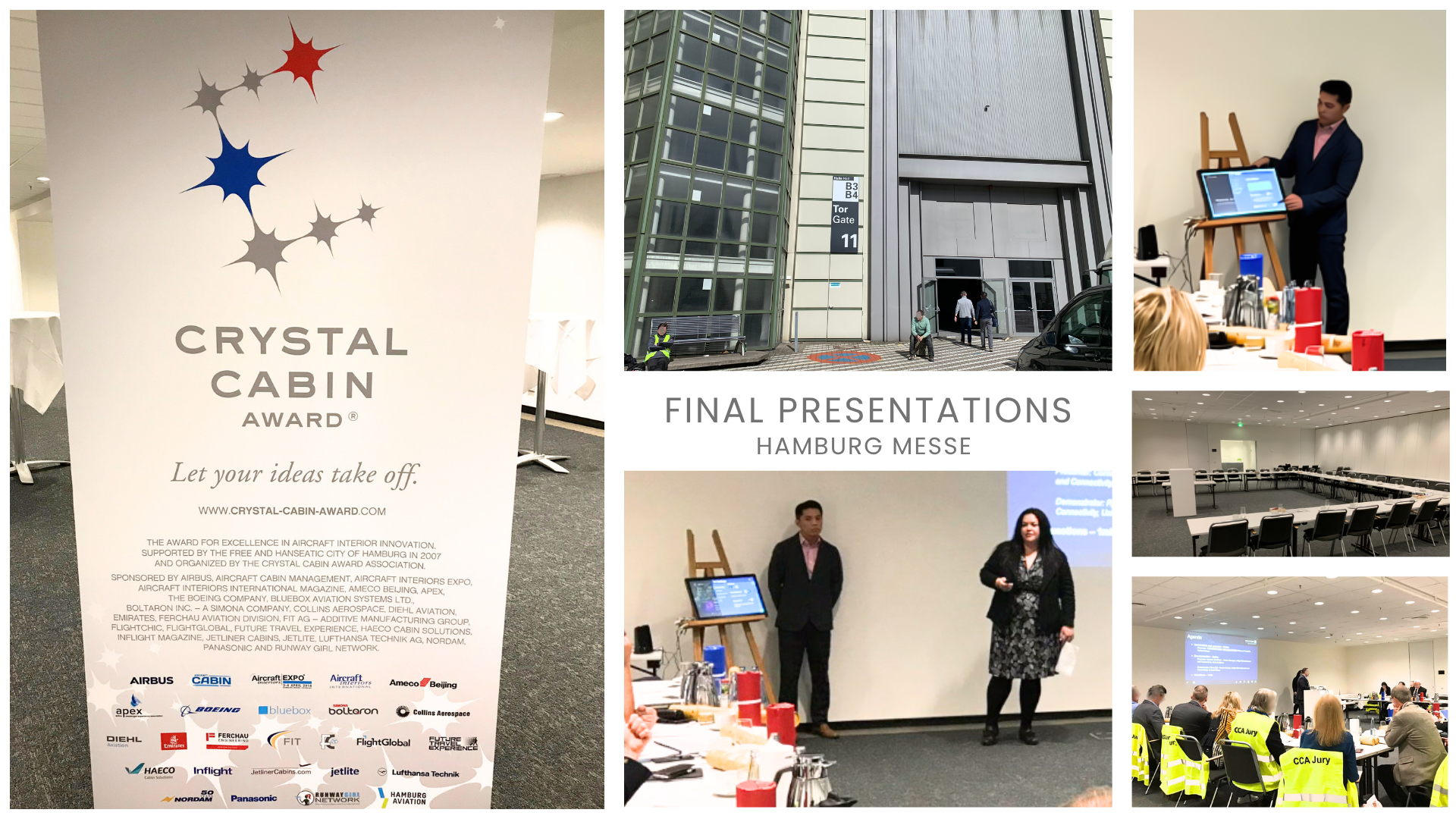
Presenting United Airlines’ Entertainment for All inflight entertainment solution to the Crystal Cabin Award judging panel in Hamburg in 2019.
"And the winner is United Airlines"
The following night we went to the awards ceremony and at that point, all the work was done. We had submitted the entry, progressed through the judging process, made the final three and delivered our presentation, so there was nothing left to do except wait.
Mary Kirby, founder and Editor-in-Chief of Runway Girl Network, presented our category that year and the awards were being livestreamed over the internet. My Dad was tuning in from Australia, members of our team were tuning in from events they were attending that night in Hamburg and from their hotel rooms, and United colleagues were watching back in Chicago.
I remember clearly Mary's speech leading into the presentation of the three finalists and then hearing the words, "The winner is United Airlines."
I still cannot properly describe that feeling. There are parts that are still a blur for me. There was excitement, pride, relief and probably a little disbelief, but above all there was the realization that something the team had worked extremely hard to build had been recognized by some of the industry's most respected experts as genuinely innovative.
United Airlines, in collaboration with Panasonic Avionics, had won the 2019 Crystal Cabin Award for Entertainment for All, and at the time that felt like the culmination of the journey. Looking back now, it was really the beginning of something much bigger because ‘Entertainment for All’ went on to win another seven awards across aviation, travel and accessibility.
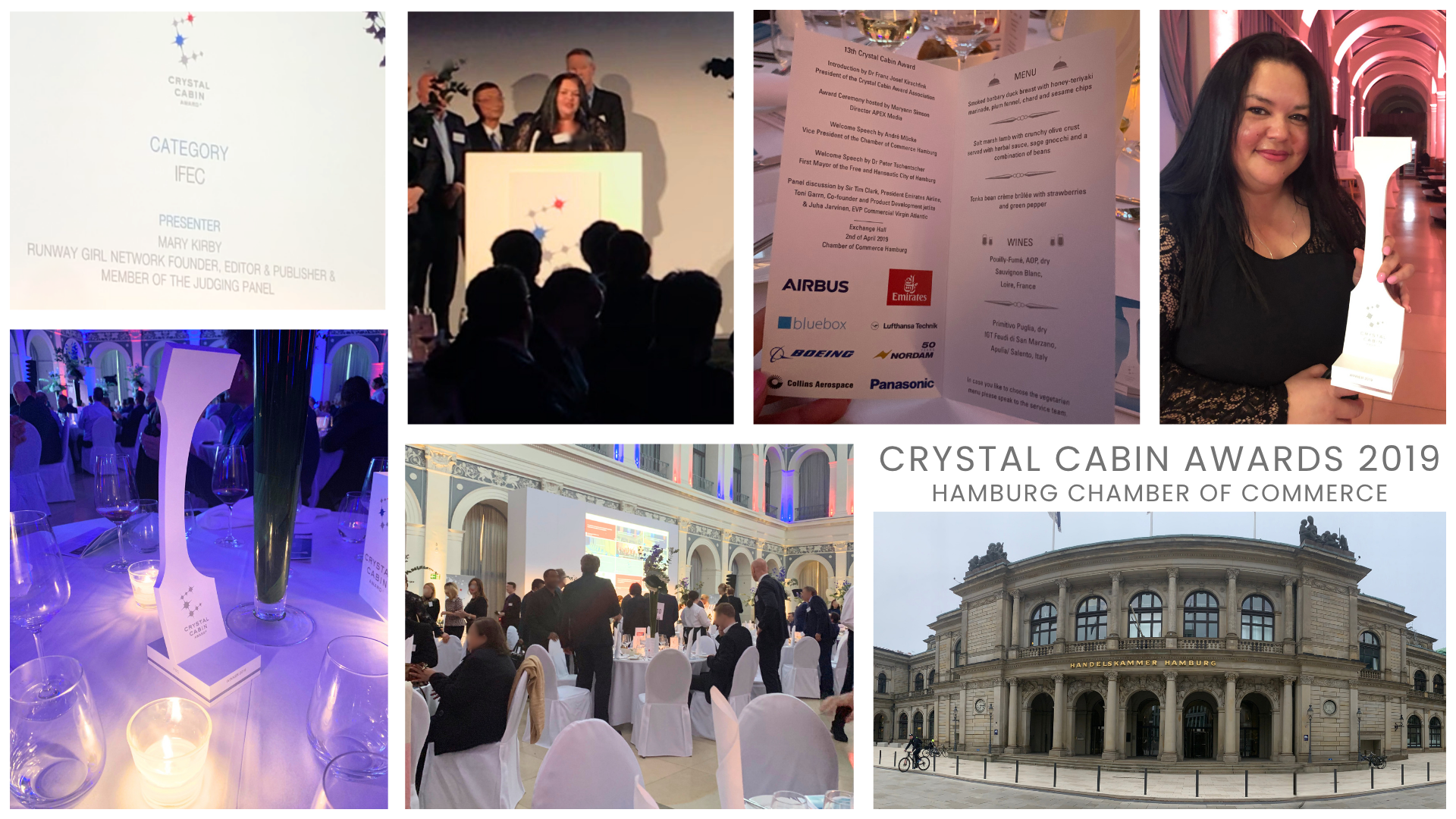
Crystal Cabin Awards 2019 at the Hamburg Chamber of Commerce, including the IFEC category presentation by Mary Kirby and the moment after United Airlines’ Entertainment for All was announced as the winner.
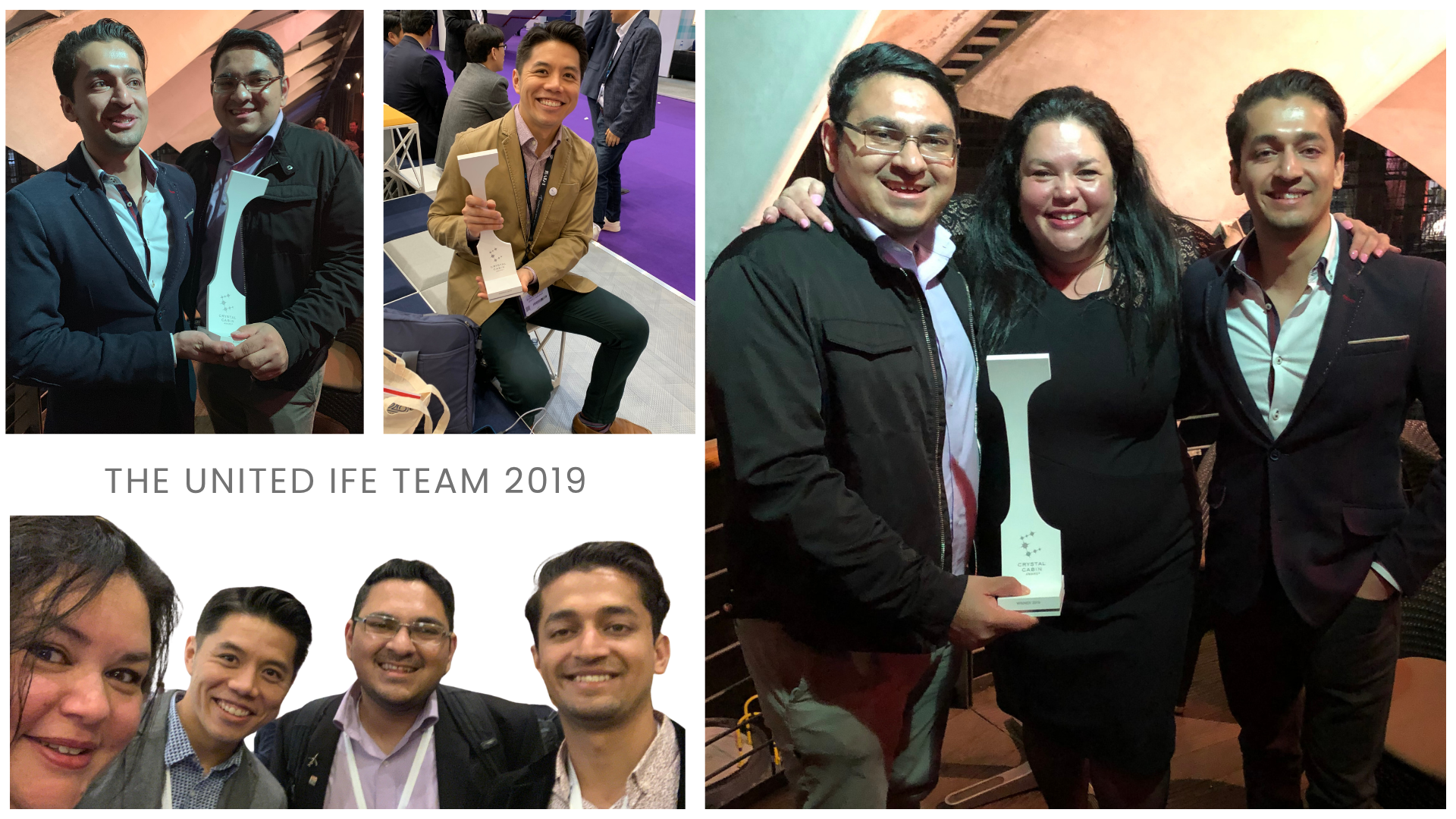
The United IFE team in 2019 - Ryan Dai, Sameer Shaikh, Jaspreet Singh and Corinne Streichert. Many people across United, Panasonic Avionics and our supplier partners contributed to Entertainment for All, but this team carried much of the day-to-day responsibility for delivering the solution. I could not have done it without them.
What I did not expect came later
What I did not anticipate in 2019 was the life that recognition would continue to have. Even now, from time to time, I receive unsolicited messages from passengers, colleagues, students and companies across the aviation industry who find me online and tell me that they experienced the system, that a particular accessibility capability made a difference to their journey or that the solution influenced how they subsequently thought about inflight entertainment, accessibility or passenger experience within their own organization.
Those messages mean a great deal to me because they reveal something that an award ceremony itself cannot necessarily measure. The impact of an innovation may not be fully evident when you launch it, and it may not even be evident when you receive recognition for it because sometimes you only begin to understand its influence years later, when somebody you have never met tells you that something your team created changed their experience or changed the way they approached a problem themselves. And to me, that is ultimately the real measure of innovation.
Seeing the Awards from both sides
After our win, my relationship with the Crystal Cabin Award changed because I was subsequently invited to join the judging panel, and since then I have had the opportunity to experience the Award from the other side of the room. That perspective has made me appreciate the process even more because as an entrant you are intensely focused on your own solution, while as a member of the jury you see the extraordinary breadth of thinking taking place across the industry.
You see major aerospace companies, airlines, established suppliers, startups, designers, engineers and universities approaching very different problems from very different perspectives, and one of the things that becomes clear very quickly is that innovation is not synonymous with complexity. Sometimes the idea that makes you stop is technologically sophisticated and sometimes it is remarkably simple, however what is important is whether it challenges an existing assumption, solves a genuine problem and creates real value.
The Crystal Cabin Award judging criteria reinforce that, with 50 percent of the assessment based on the degree of innovation and passenger benefit and operator benefit each representing 25 percent. I believe that balance is important because a product can be technically fascinating and still fail to solve a real problem, while a passenger experience concept can sound compelling but be extremely difficult for an airline to implement or sustain operationally.

Corinne Streichert during Crystal Cabin Award judging in Hamburg, reflecting the journey from 2019 entrant and winner to member of the jury.
What the Crystal Cabin Awards do for innovation
We work in an industry that produces an enormous number of product launches, announcements and claims of innovation, and not everything described as innovative actually is. One of the important functions of the Crystal Cabin Award is its ability to apply independent scrutiny to those claims while also giving strong ideas visibility beyond the companies and teams that created them.
Entries move through a multi-stage evaluation process before three finalists in each category are selected and invited to present their solutions to the judging panel, after which intense deliberations take place, with the entries scrutinized by the judges and winners determined by a secret ballot. That process gives meaningful innovation something increasingly difficult to achieve in a crowded market, which is credible visibility in front of people who may be able to take an idea further.
A good idea seen by the right airline may become a product, a university concept may influence an engineer, a startup may meet a future partner, a supplier may begin looking at a passenger problem differently or an airline may discover that another organization has solved something it has been struggling with internally.
Innovation rarely develops in isolation because industries move forward when ideas are exposed, challenged, adapted and improved, and the Crystal Cabin Award helps create an environment where that can happen.
Why I would encourage you to enter
The 2027 Crystal Cabin Award is particularly significant because it marks the Award's 20th anniversary, and submissions are now open across eight categories covering Accessibility, Breakthrough Start-Ups, Cabin Concepts, Cabin Technologies, IFEC & Digital Services, Passenger Comfort, Sustainable Cabin and University. The submission period closes on 21 November 2026, with the winners to be announced in Hamburg, Germany, on 6 April 2027 during Aircraft Interiors Expo.
For anyone thinking about entering, I would say do not get too caught up in whether you think you can win. Of course you should believe in your product, as we absolutely did, but there is value in the process itself that you may not fully appreciate at the start.
Putting the submission together made us step back and really challenge our own thinking about what was innovative, what evidence supported that and what made the solution different. It also made us get very clear on who benefited from it and whether we could explain its value in a way that would make sense to someone who had not been part of developing it and was not familiar with the intricacies of inflight entertainment.
Should you reach the final, there is another test because you have to walk into a room of some of the world's most experienced aircraft interiors experts and make them understand, in just a few minutes, why your solution deserves to be considered the winner.
I have been the person preparing that submission, the person standing in that room making the pitch and the person sitting at the awards ceremony hoping to hear our company's name, while today I am one of the people sitting on the other side evaluating what the next generation of innovators are bringing forward. That gives me a unique perspective on the value of the Crystal Cabin Award, but it has also shown me how difficult it is to predict what can happen after you decide to put an idea forward.
Your idea may be the next one
Aviation has no shortage of difficult problems to solve because passengers want greater comfort, better connectivity, more intuitive technology, stronger accessibility, increasingly seamless experiences and value for their money, while airlines simultaneously need solutions that are reliable, certifiable, maintainable, operationally practical, economically viable and increasingly sustainable. Those constraints can make innovation harder, but they also make it more necessary.
The next important aircraft interior innovation may already exist inside an airline project team, a supplier's engineering department, a startup, a design studio or a university, and perhaps the people developing it are debating whether it is ready or wondering whether what they have built really is different enough. I understand that feeling because in 2018 we were asking ourselves many of those same questions.
We entered, we became finalists and we walked into that room in the Hamburg Messe on the Monday and made our case, and then the following evening in April 2019 I heard Mary Kirby say the words I will never forget, "The winner is United Airlines."
What I could never have known when I sat down to prepare that submission in 2018 was where that decision would lead. I could not have predicted the additional recognition the product would receive, the passengers and industry colleagues who would contact me years later, the conversations it would influence or that I would eventually find myself sitting on the other side of the room as a member of the Crystal Cabin Award judging panel.
That is probably the strongest reason I can give anyone considering entering the 2027 Awards. If you believe you have created something genuinely innovative, put it forward because you cannot know where the recognition, visibility and exposure of that idea might ultimately lead, or whose passenger experience, product development or thinking it may influence long after, even years after, the awards ceremony is over.
Disclaimer: The views expressed in this article are my own and reflect my personal experience as a former United Airlines employee, Crystal Cabin Award entrant and winner, and current member of the Crystal Cabin Award judging panel. They do not represent the official views of United Airlines, the Crystal Cabin Award organization or their respective partners.